
Last updated September 20, 2026
Free on-site gate assessment - hinges, posts, and your LiftMaster or Nice gate operator checked before anything is quoted
The assessment is free and the quote is the invoice.


 Before
 After
After Before
 After
After Before
 After
AfterSeasonal Gate Repair Care for Missouri City: Year-Round Homeowner’s Guide
A gate that worked fine in February can fail in August on the same fault that was always there. The reason is simple physics: Houston-area heat expands an aluminum track by nearly a quarter inch over a 20-foot run, and the operator that had enough torque in 60-degree weather doesn’t at 95. This guide explains what actually breaks on driveway gates in Missouri City, when it breaks, and what to do about it before you’re parked at the curb with a gate that won’t move. For a deeper dive, see The Complete Guide to Gate Repair in Missouri City. You’ll learn which months to check welds, why your gate shifts after spring rains, and what to do with your gate system before a named storm enters the Gulf.
Quick Answer
Missouri City doesn’t have four equal seasons. It has a humidity season, a heat-expansion season, a brief freeze window, and a storm season, each stressing a gate system differently. Match maintenance to those windows instead of a generic quarterly schedule: inspect welds and battery terminals in spring, check track gaps and thermal clearance in summer, test battery backups and hydraulic fluid in winter, and physically secure or disconnect the gate before any named storm.
Table of Contents
- Why Gulf Coast Humidity Eats Gate Welds: The Spring Corrosion Window
- How Heat Expansion Changes Slide Gate Track Gaps: The Summer Problem
- The December-February Freeze Window: What Cold Does to Hydraulics and Batteries
- Storm Season Prep for Missouri City Gates: What to Lock, Disconnect, and Check
- Clay Soil Movement and Gate Post Alignment: The Spring Inspection Item
- A Missouri City Gate Maintenance Checklist by Season
- Common Mistakes to Avoid
- When to Call a Professional
- Frequently Asked Questions
- The Bottom Line
BeforeAfterWhy Gulf Coast Humidity Eats Gate Welds: The Spring Corrosion Window
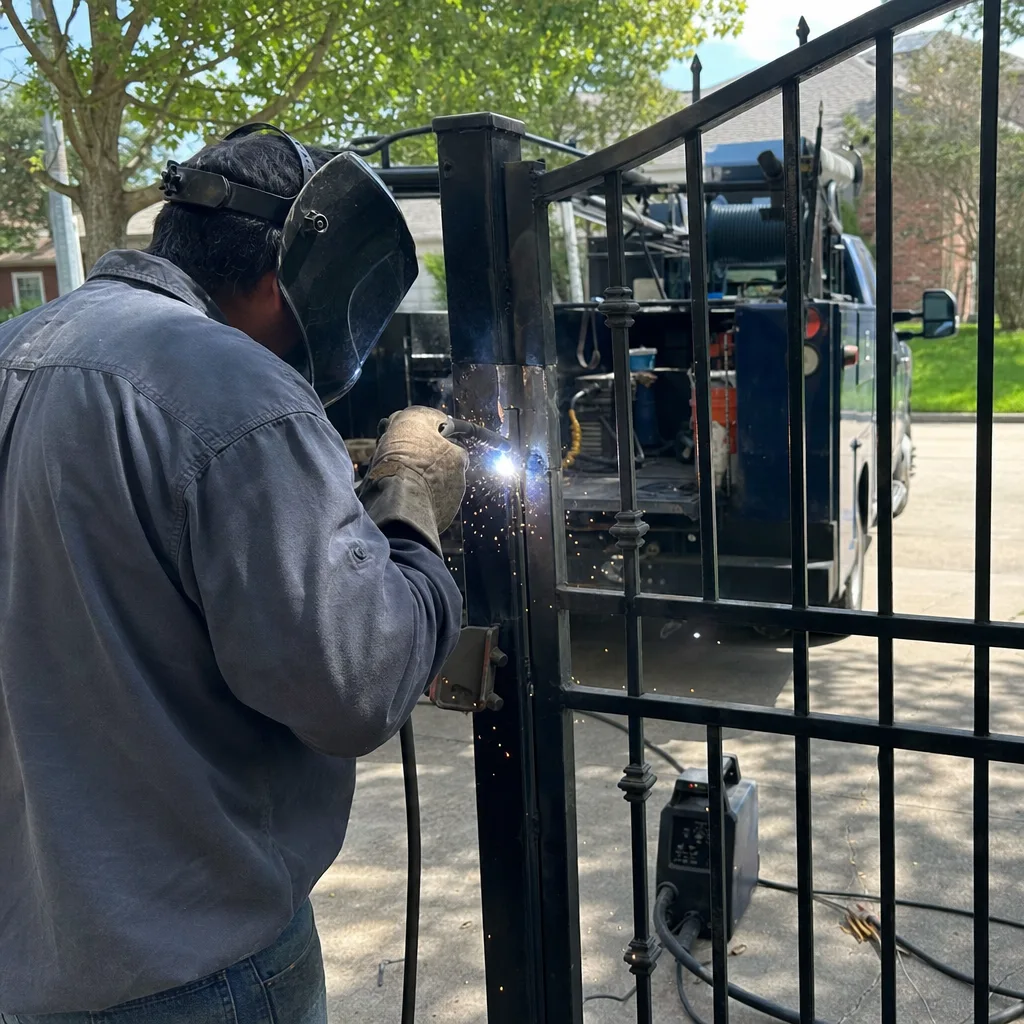
Missouri City sits close enough to the Gulf that ambient moisture is a constant, not a season. But spring is when it does the most damage. March through May brings high humidity plus wide temperature swings, and that combination forces condensation onto every metal surface on your gate, including the parts you never see. Weld seams are the most vulnerable. A weld is a joint where two dissimilar heat-affected zones meet, and moisture collects in the microscopic pores around those seams. Once corrosion starts there, it travels along the seam and weakens the structural connection.
In our experience, weld-point rust on gate frames in Missouri City follows a predictable pattern. The bottom hinge plate on a swing gate and the roller brackets on a slide gate tend to show rust first, because those spots trap water and don’t dry quickly. We’ve also seen rust develop inside the lower rail of aluminum gates where weep holes get blocked by dirt or mud splatter. The steel inside an aluminum frame can corrode for months before anything visible appears on the surface.
What to check in March and April:
- Hinge plate seams on swing gates: look for rust blooms or flaking paint at the corners where the plate meets the gate frame.
- Roller bracket welds on slide gates: use a flashlight to inspect the underside of the bracket, where water drips and sits.
- Weld seams on decorative steel gates: run a gloved hand along the seam length. Roughness, raised edges, or orange staining means oxidation is active and spreading.
- Weep holes on the bottom horizontal rail of any tubular gate: clear them with a small pick or wire. A blocked weep hole holds water inside the rail year-round.
For rust already established on a visible seam, treatment is straightforward: wire-brush the area to bare metal, apply a rust-inhibiting primer, and repaint with an automotive-grade enamel rated for exterior metal. If the seam has lost thickness or shows pitting deeper than a thumbnail scrape, call a specialist in Gate Repair services before the gate’s own weight turns that seam into a structural crack. Gates in Missouri City fail more often from corrosion at the seams than from motor problems.
How Heat Expansion Changes Slide Gate Track Gaps: The Summer Problem
Slide gates in Missouri City run on a track, and the gate rides that track on rollers or guide wheels. The critical clearance is the gap between the gate’s top guide rollers and the post-mounted guide bracket. In cool weather, that gap is whatever the installer set it to. In August, the gap is smaller. Much smaller.
Aluminum expands at roughly 12 to 13 millionths of its length per degree Fahrenheit of temperature rise. A 20-foot aluminum gate that’s 70 degrees on a January morning will be about 0.22 inches longer at 100 degrees in July. Steel expands less, about 6 to 7 millionths, but still enough to matter. That quarter-inch of expansion doesn’t sound like much, but it’s the difference between a gate that glides and a gate that binds. When the gate binds, the operator draws more current to force it through the travel. That overheats the motor windings, wears the limit switch contacts faster, and eventually trips the thermal overload or burns out the capacitor.
Heat expansion also affects the gate’s own internal tension. Swing gates with diagonal bracing can develop a slight sag in summer because the metal frame expands more than the open spaces between pickets, shifting the center of gravity by millimeters. That’s enough to make a swing gate drag on the latch side or sit a half-inch lower in the receiver.
What to check in June through September:
- Top guide roller clearance. Watch the gate travel while someone operates it. If the gate hesitates or chatters mid-travel, the guide rollers are likely too tight for the expanded frame. The roller should maintain light contact with the guide channel throughout travel, not grind against it.
- Track cleanliness. Summer dust and grass clippings pack into section gaps in the track and bake into a hard crust. Clean the track with a stiff brush, then check for pebbles or debris wedged under the V-groove wheels.
- Limit switch position. In our experience, Missouri City summers push limit switches slightly out of calibration because the operator repeats the close cycle against a gate that’s now slightly longer. If the gate reverses an inch or two after closing, the close limit may need to be reset.
- Motor housing temperature. After 10 or 12 open-close cycles in 95-degree weather, the motor housing should be warm, not too hot to hold your hand against. A housing that’s scorching means the operator is working too hard, likely because of gate drag rather than the ambient heat alone.
If your gate drags in the heat, don’t adjust the guide rollers yourself without marking their original position. Loosen, shift, and tighten in 1/16-inch increments, and photograph each adjustment. When we service gates in the Sienna and Riverstone areas during July and August, thermal binding is the single most common repair call. A five-minute guide-roller adjustment often clears it.
The December-February Freeze Window: What Cold Does to Hydraulics and Batteries
Missouri City doesn’t get hard freezes often, but when it does, gate systems designed for the Gulf Coast show their weak points. The two components most affected by cold are hydraulic operators and battery backup systems.
Hydraulic gate operators use oil to move the gate piston. Cold thickens that oil. A hydraulic operator that swings a gate smoothly at 60 degrees will labor at 25 degrees because the pump is pushing viscous fluid through a narrow orifice. The pump draws more current, the motor runs hotter, and the cycle time stretches out. If the oil has absorbed moisture over the years, that moisture can freeze and form ice crystals inside the pump chamber. A single hard freeze can damage an older hydraulic pump that ran fine for a decade in normal Gulf Coast weather.
Battery backups fail in the cold even faster. Lead-acid batteries lose roughly 30 to 40 percent of their cranking capacity at 32 degrees compared to 77 degrees. A battery that held enough charge in October may not have enough in a February freeze. And the freeze always seems to arrive with a power outage, which is exactly when you need the battery.
What to do in December and January:
- Replace backup batteries older than three years before the freeze window. The date code is stamped on most batteries. If it’s fading or past three years, replace it now, not after the next cold front.
- Check hydraulic oil level. The reservoir sight glass should show oil at the mid-to-full mark when the gate is in the closed position. Low oil or dark, murky oil in a hydraulic operator means it’s time for service.
- Run a battery-only cycle test. Turn off the main breaker to the gate operator, then open and close the gate on battery power. If the gate moves slower than normal or stops mid-cycle, the battery bank is marginal.
- Lubricate hinges and rollers with a cold-rated grease. Standard grease stiffens in cold weather. Use a lithium-based or synthetic grease rated for subfreezing temperatures on hinge pins and wheel bearings.
When the freeze does hit Missouri City, don’t force a gate that won’t move. A frozen hydraulic line or a cold-stalled motor that’s forced by hand can shear internal components. Give the system an hour in the sun, then try again. If it still won’t move, call a gate professional rather than repeatedly cycling the operator. Repeatedly stalling a cold motor is how capacitors blow.
Storm Season Prep for Missouri City Gates: What to Lock, Disconnect, and Check
Storm season in Missouri City isn’t a single month, it’s June through November, with the highest risk window from August through early October. The preparation question isn’t whether a storm will come. It’s what your gate does when one arrives.
The biggest storm threat to a gate system isn’t wind, it’s water and electrical surge. Wind doesn’t usually break a well-installed gate. Storm surge and street flooding destroy control boards, transformers, and low-voltage wiring. A lightning strike miles away can send a surge through the power grid and into the gate’s control board, and that board is the brain of the entire system.
Before a named storm approaches:
- Disconnect the operator. For slide gates with an operator, disengage the manual release and secure the gate in the open or closed position with a sturdy chain and padlock through the frame and a fixed post. Don’t leave the gate to slam against its limit stops in high wind.
- Secure swing gates. For swing gates, place a chain or strap across both gate leaves and through the latch post, then drive the latch bolt or receiver to full engagement. A swing gate that blows loose in wind will fold back against the hinges and bend the gate panel or the post.
- Unplug or switch off the main breaker to the operator. This is the single most effective surge protection. A breaker that’s off can’t deliver a spike into the control board. Do this before the storm arrives, not after the lights flicker.
- Photograph the gate and operator position. Document the gate’s closed position, the chain or strap placement, and the breaker state. If the gate is damaged in the storm, you’ll have a baseline for the insurance claim and the repair.
- Remove loose items near the gate. Potted plants, yard tools, and trash bins become projectiles in 80 mph gusts. Anything within 15 feet of the gate track should be moved or brought inside.
After the storm passes, check before you re-energize. Look for standing water inside the operator housing, mud packed into the track, and any debris that’s wedged between the gate and its posts. If the control board shows a blinking fault code, don’t assume it’s damaged; many boards latch onto a fault and need to be reset. But if the board smells of ozone or shows scorch marks on the terminal strip, it took a surge and will need replacement. This is also the time to check the gate’s battery backup if it discharged during the outage, because once the grid returns, the charge circuit may not recover a deeply depleted battery bank.
Clay Soil Movement and Gate Post Alignment: The Spring Inspection Item
Missouri City sits on expansive clay soils, the same gumbo clay that heaves concrete slabs and shifts fence posts across Fort Bend County. Wet spring months saturate that clay and make it swell. Dry summer months shrink it. The result for gate posts is slow, incremental movement, year after year.
A gate post that’s moved out of plumb by just half a degree changes the gate’s entire geometry. Swing gates sag on the latch side. Slide gates bind on the guide rollers. The operator’s torque requirements go up, the motor runs hotter, and the gear train wears faster. What looks like a motor problem is very often a post problem that started in the soil.
Signs that clay soil has shifted your gate posts:
- The gap between the gate leaf and the latch post is visibly wider at the top than at the bottom, or vice versa.
- The gate has started to scrape or drag at one corner of its travel.
- You can see hairline cracks radiating from the base of a gate post where it meets the concrete collar.
- The gate’s self-closing feature or the automatic close timer no longer returns it to a consistent position.
Spring is the right time for this inspection, not fall. By spring, the winter moisture has done its work on the clay, and any post movement that happened over the wet season is visible. You’re also not fighting summer heat while you make adjustments, and the gate has months of dry weather to settle into any realignment.
Fixing post alignment isn’t a do-it-yourself job for most homeowners. It involves shimming, resetting plumb, and in some cases excavating and re-setting the post in fresh concrete. What you can do in the spring: mark your post bases with a permanent marker at a fixed reference point, then check the distance from the mark to the gate frame once a month through August. If that distance changes, the post is moving, and you have documented data to give a gate professional when you call.
A Missouri City Gate Maintenance Checklist by Season
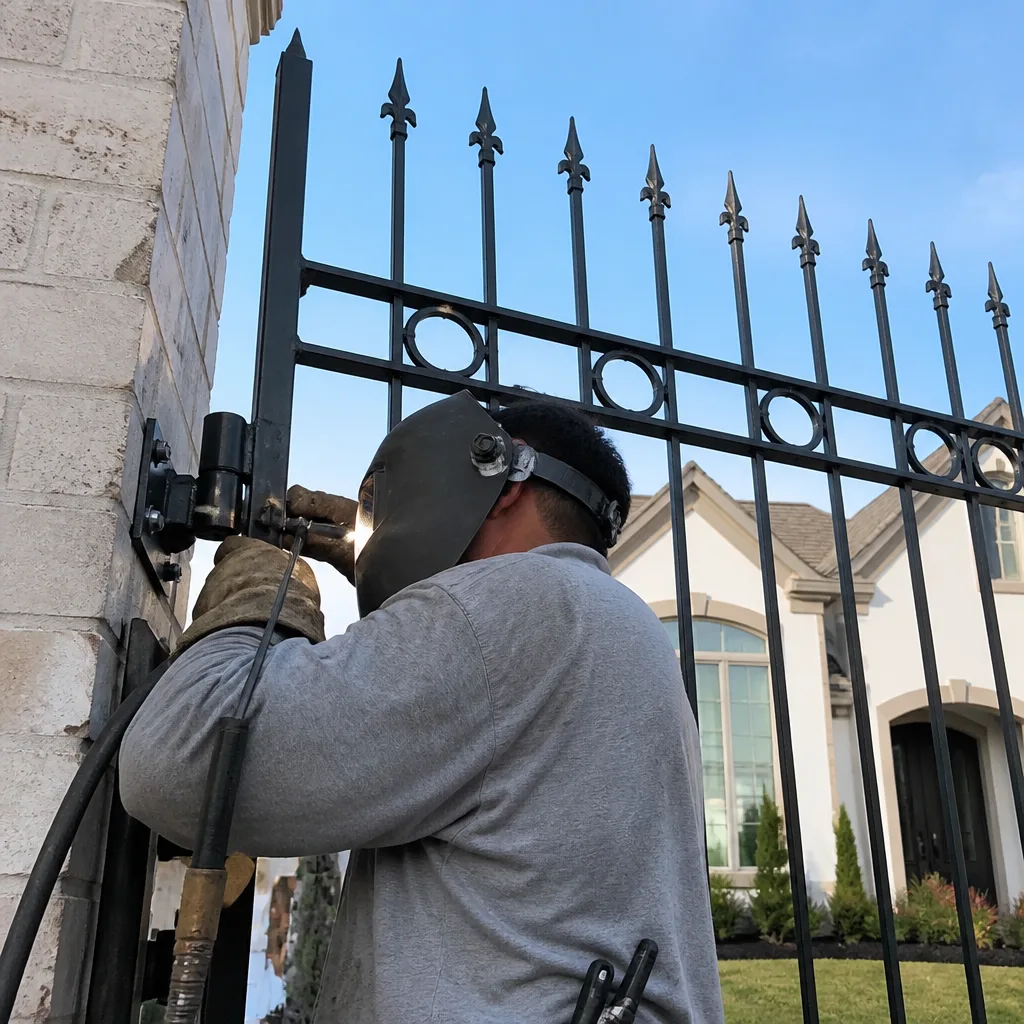
Here’s a consolidated checklist of the actions we’ve covered, organized by when to do them in Missouri City’s climate cycle. This isn’t a generic quarterly schedule. It’s matched to what actually happens throughout the year.
Spring: March-May
- Inspect all weld seams on the gate frame and hinge plates for rust or cracking.
- Clean tree pollen and dust from the gate track and the operator housing vents.
- Check gate post alignment using a fixed reference mark and monitor through summer.
- Test the operator’s auto-reverse sensor with a traffic cone or a rolled-up towel.
- Clear weep holes on the bottom rail of tubular gate frames.
Summer: June-September
- Check slide gate top guide roller clearance and listen for binding.
- Clean the track weekly during heavy grass-growing periods.
- Monitor motor housing temperature after multiple open-close cycles.
- Verify that the gate’s close limit position hasn’t shifted due to thermal expansion.
- Reseal any paint chips or scratch spots opened during spring inspection and treatment.
Fall: October-November
- Complete storm-season prep if you haven’t already, including breaker-off practice.
- Inspect the battery backup bank and replace anything past its service life.
- Lubricate all hinge pins and wheel bearings with a cold-rated grease.
- Photograph gate position and any existing damage for storm-season baseline records.
Winter: December-February
- Check hydraulic oil level and color in hydraulic operators.
- Run a battery-only cycle test by turning off the main breaker.
- Verify that freeze protection on the operator, if equipped, is enabled and functioning.
- Don’t force a gate that won’t move after a freeze. Let it thaw, then call if it stalls.
If you do these checks in the right month, you’ll catch most gate problems before they become emergency repairs. The ones you miss will be the ones you can see coming, not the ones that surprise you at 11 pm. Browse our more guides & resources for year-round gate maintenance tips.
Common Mistakes to Avoid
- Ignoring rust because the gate still opens fine. Weld corrosion is progressive and quiet. By the time a seam fails audibly, the repair is structural rather than cosmetic, and the cost multiplies.
- Adjusting limit switches without marking the original position. A limit switch that’s adjusted by guesswork can send a gate crashing past its travel or leaving a gap you didn’t intend, creating both safety and security issues.
- Lubricating the gate track on a slide gate. Grease on a track collects dust and grit, making friction worse. Tracks run clean and dry. Grease the rollers’ bearings, not the rolling surface.
- Waiting until August to think about heat expansion. The time to check guide roller clearance is in June, before the hottest weeks arrive. By mid-August, the gate has already been binding for weeks.
- Leaving the gate operator energized during a named-storm watch. The breaker-off habit costs nothing and saves control boards. A surge doesn’t care how new your operator is.
- Assuming the motor is broken when the real problem is a shifted post. Post movement causes binding that overloads the motor, but replacing the motor without fixing the post just burns through another motor in a year or two.
- Skipping the battery backup test until the power goes out. Battery backup systems degrade slowly. If you only discover the failure during an outage, you’ve already lost the benefit the backup was meant to provide.
When to Call a Professional

Call a gate professional when you see a structural crack in a weld seam, when the gate post has visibly shifted, when the operator smells hot or trips its thermal protection, when the battery backup fails a cycle test, or when a storm has left water damage inside the operator housing. These are not adjustment problems; they’re repair problems. Gate repair in Missouri City is the service to call for any of these conditions, and the inspection itself is how you avoid guessing wrong about the cause.
Vance Gate Repair Missouri City offers free estimates in Missouri City. Call (346) 253-1761 and we’ll send a background-checked technician to inspect the gate, document what we find, and hand you a written price before any work begins.
Frequently Asked Questions
Most gate repairs in Missouri City run between $175 and $650 depending on the part and the labor involved. A guide roller adjustment might cost under $200, a limit switch replacement typically runs $180 to $320, and a motor or control board replacement can run $400 to $900 depending on brand and availability. Call (346) 253-1761 for an exact quote on your specific gate. Estimates are free, and the price is written before any work starts.
Yes. We operate 24 hours a day, seven days a week, and a live person answers the phone at any hour. Emergency dispatch is available for gates that are stuck open, stuck closed, or otherwise leaving the property unsecured. Call (346) 253-1761 and you’ll speak with a person, not an answering service.
Yes. We service nine major gate-automation brands, including DoorKing, Elite, Mighty Mule, LiftMaster, FAAC, BFT, Linear, Viking, and Ghost Controls. We don’t steer you toward replacing a motor that can be repaired. If the motor on your gate is still serviceable, we’ll tell you that and give you our repair recommendation in writing.
A full gate installation in Missouri City includes the gate panel or panels, posts or columns, hinges or track system, operator and control board, safety sensors, and all necessary wiring and conduit. We provide a written scope and a written price before installation begins. The install is not done until the gate is tested through its full travel with the safety sensors in place.
Yes. Power supply, conduit, low-voltage wiring, photo-eye placement, and edge sensor installation are all part of the installation scope we cover. Every installation includes safety sensors positioned to stop and reverse the gate when something crosses the path. This is covered in our gate motor and opener service in Missouri City as well.
A storm can damage a gate system through electrical surge, even without flooding. Lightning strikes miles away can send voltage spikes through the grid and into the control board. The board may show a fault code, or it may be dead entirely. If the breaker was left on during the storm, the board is the most likely component to have taken the hit. Call (346) 253-1761 for a diagnosis. We document what we find with photos and give you a written price before any repair begins.
The Bottom Line
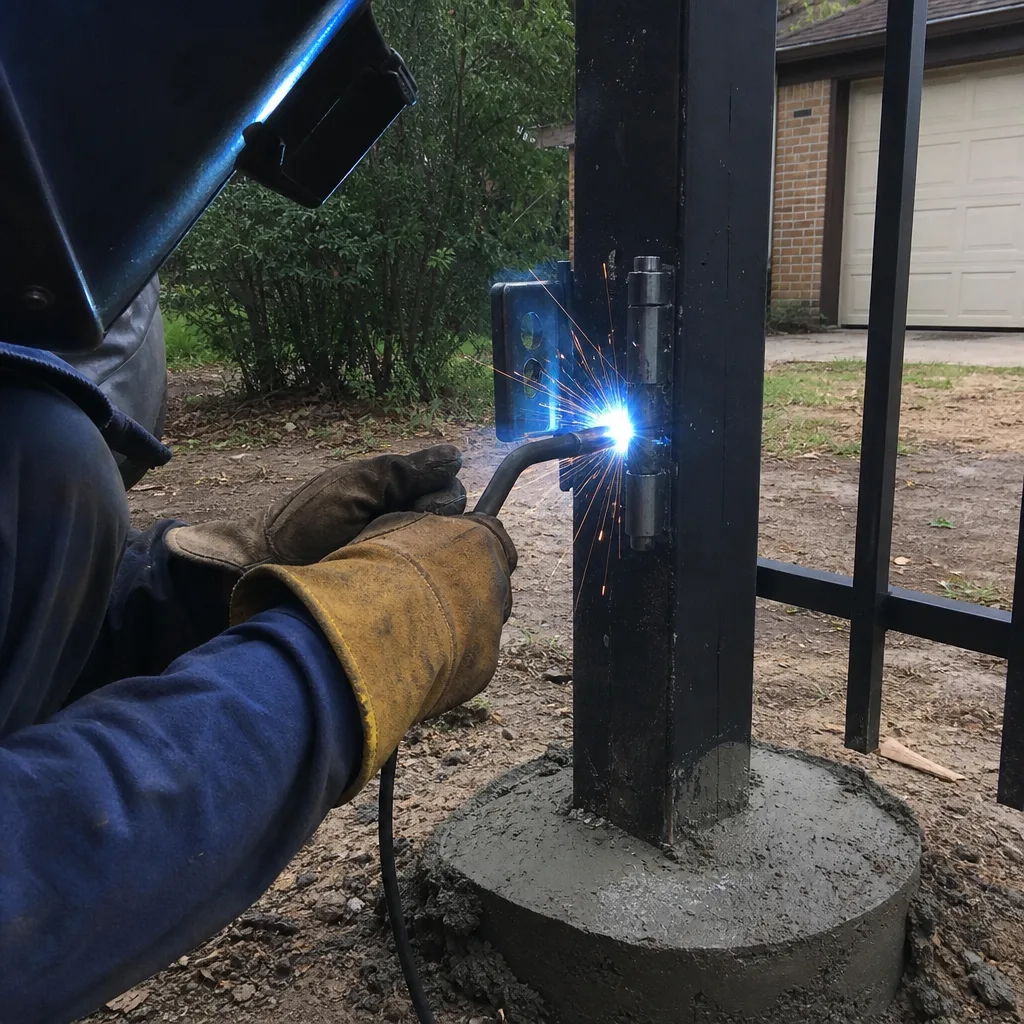
Missouri City gates respond to four distinct seasonal stress patterns: humidity corrosion in spring, thermal expansion in summer, freeze effects on hydraulics and batteries in winter, and storm surge risk from June through November. Matching maintenance to those windows costs less than waiting for a failure and prevents most emergency calls. Check welds in March, guide rollers in June, battery backups in December, and breaker discipline all through storm season. When something looks wrong, document it. Get a written price before any work starts. Vance Gate Repair Missouri City home is the direct resource for Missouri City gate service, and the phone number is (346) 253-1761 when you need to call.
Written by Adrian Vance, Owner at Vance Gate Repair Missouri City, serving Missouri City since 2014.